
Commercial Roofing in Heath, TX
A commercial roof in Heath needs a building-level inspection, even when the property is part of planned local growth. Heath updated its comprehensive plan in June 2025 to guide development and public investment. The Heath Towne Center Overlay concentrates planned commercial activity around a broad multi-road intersection area, with the plan supporting low-intensity commercial uses, local retail, open space, and a diversified economy. Those land-use goals do not identify a roof system or current tenant. We confirm the property contact, access route, and reported condition before setting repair limits.
At the first visit, we locate the interior symptom, check the roof plan if available, and identify what area can be safely released. The manager confirms lift placement, equipment status, pedestrian routes, and any hours when the building must remain quiet. We then inspect the field surface and nearby transitions, including seams, curbs, drains, penetrations, and perimeter details. A commercial roof assessment in Rockwall or roof inspection for a Forney property has separate local access needs. Heath work follows the property's conditions and the observed roof assembly.
How Does Towne Center Planning Affect the Visit?
The overlay defines a broad commercial area rather than a single storefront or operating facility. Planned retail and low-intensity commercial uses can involve different access, customer, or service requirements, but we confirm the actual activity with the property contact. We ask which entrance stays open, whether deliveries share the work route, and where barriers can stand without blocking access. The scope is tied to the approved roof area, not to a district label.
Heath's 2025 plan provides a current framework for development and public investment. During a roof project, the useful record is the building's own assembly, repair history, and outstanding condition. If a property is being modified, we identify open transitions, temporary protection, and the trade responsible for each connection before roofing proceeds. A roof condition report with a marked plan can document current observations before construction changes them.
When the roof sits above occupied space, a safe sequence matters. We agree on the route to the roof, the interior area below, the work limit for the shift, and the closure expected before the crew leaves. A commercial reroof plan for an active building can divide work into sections and show how each handoff will be recorded.
What Should Be Checked Around a Leak?
We trace from the interior symptom toward likely openings above it. Water can travel along a deck or insulation layer, so the ceiling mark may not align with the entry point. The roof walk checks field seams, patches, curb flashing, penetrations, wall transitions, drains, scuppers, and edge metal. We photograph conditions and mark locations on a roof plan where possible. Any section that cannot be accessed safely is named as a limit with the additional access needed.
A drain check follows the water path instead of stopping at the grate. We inspect strainers, bowls, scupper openings, overflow routes, nearby seams, and low spots that retain water. If an outlet is clear but a pool remains, the roof may need testing for slope, insulation, or deck conditions. A ponding-water roof inspection can locate a test area and explain which results would change the repair.
In Mesquite's DFW market, the July and August daily high typically runs through the 90-degree range, and 100-degree readings also occur. Those regional conditions affect material handling and crew exposure, so we check actual roof temperatures before work. We check the product requirements and conditions on the roof before welding, bonding, or applying coating. The regional climate supports a planning check, not a claim that a particular roof has failed from heat.
How Do You Choose a Repair or Replacement?
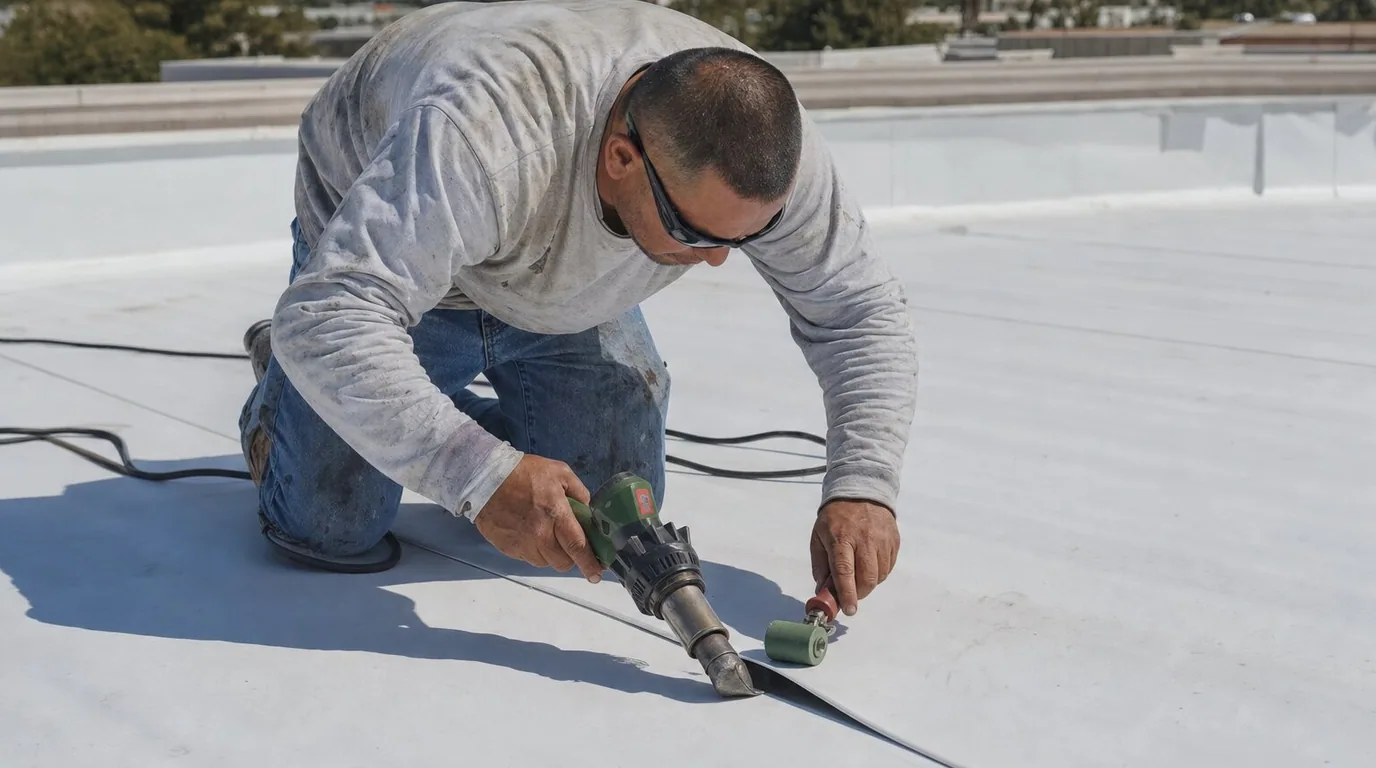
A targeted repair is appropriate when the damaged detail is bounded and the adjacent material remains sound. We identify the system first, then prepare compatible material and connect it to the existing assembly. At a curb or penetration, the flashing transition must close into the field. A seam repair also needs nearby attachment and surface condition checked. The proposal lists preparation, materials, limits, and any condition that would require the owner to approve more work.
If moisture may be below the membrane, a controlled test opening can show whether insulation is wet or the deck needs attention. The location and result are photographed. Confirmed quantities stay separate from an allowance until the owner reviews evidence. When failures repeat or moisture covers more than one section, we compare local repair with a broader restoration or replacement using the same plan and access assumptions. commercial roof repair is scoped to observed failures; replacement planning should include removal, dry-in, protection, and transitions that must be rebuilt.
Drain outlets, wall flashing, and roof edges can be part of the same water path. A drain and scupper service can include the outlet and the adjoining membrane detail. We do not price a sealant touch-up as the full repair when nearby flashing also needs work.
What Conditions Can Move the Schedule?
The Mesquite market sits in a region where spring storms bring hail, damaging wind, flooding, and tornado risk nearly every year. That regional season does not mean each Heath property experiences each hazard. After a site reports storm activity, we check the affected area for displaced edge metal, impact marks, open seams, punctures, or debris. A storm-damage roof review records the observed condition and any test still needed.
Rain timing, wind at roof height, surface moisture, and temperature can determine which work can proceed. We check the forecast and material requirements before opening the roof. If the section cannot be closed safely during the planned window, we protect the boundary and return under suitable conditions. For active water entry, temporary roof protection may limit exposure while a permanent detail is defined.
The proposal prices measured sections, access equipment, installed assembly, material availability, concealed conditions, and the shifts the property can release; those details also set a workable duration. A property with customer routes or occupied rooms may need barriers and notices. We document those assumptions before scheduling and confirm changes with the property contact.
What Should the Property File Preserve?
We hand over a marked roof map, completed-task summary, installation notes, photo record, and test findings. Separate notes identify any detail postponed for access or weather. The manager can compare the completed scope with the original leak report and see what remains to be checked. If a test opening found wet insulation, the file records the location and restoration separately from surface repairs.
A consistent record can help a property team plan maintenance and capital work as the Towne Center area develops. It distinguishes observed condition from a recommendation and completed work from a future option. If several roof systems exist, each assembly should retain its own labels and history. A roof condition and repair record can keep those notes organized for later review.
For service in Heath, give us the building location, the person who can release roof access, the affected room or section, and a suitable work period. We will confirm the inspection route before dispatch.
Commercial Roofing Questions
Does the Towne Center Overlay describe my current roof or tenant?
No. It addresses a broad planned commercial area. We confirm the building's actual use, installed system, and roof condition with the property contact.
Can a repair be phased around customer or employee access?
Yes. We can define smaller roof sections, barriers, and shift-end closures when the property representative approves the route and work window.
What should I send if the leak has stopped?
Share when it appeared, where it showed inside, any photos, and the roof plan. We can inspect nearby details and note what test would help reproduce or locate the path.
When might a test opening be needed?
A test may help when wet insulation or deck damage is suspected and surface observations cannot set the removal limit. We explain the test location and what each result would change.
Is emergency cover the same as a completed repair?
No. Temporary protection limits immediate exposure. The closeout identifies its boundary and the follow-up needed to restore the permanent roof detail.
Schedule a Roof Inspection in Heath, TX
Share the property address, roof plan, reported condition, contact, and access window. We will inspect the approved roof section and explain the next work step.

Work planned around the building and its daily operations.